





If SEO feels harder to comprehend than it used to, you’re not imagining things. In fact, many brands are in the throes of an “SEO is dead” panic. With over 36 million people predicted to use generative AI, like ChatGPT, Claude, and Gemini, as their primary online search tool by 2028, many assume Google’s days are numbered.
But they’re wrong. Google still accounts for nearly 90% of all searches worldwide. SEO hasn’t died; it’s simply evolved, and businesses must adapt their strategies right alongside it.
What Generative AI Has Changed in Search
Generative AI hasn’t replaced Google. People are still searching constantly. What has changed is how search engines respond.
While people may use Google four or five times a day, AI agents comb the internet for information around the clock, 24/7. It’s like search on steroids.
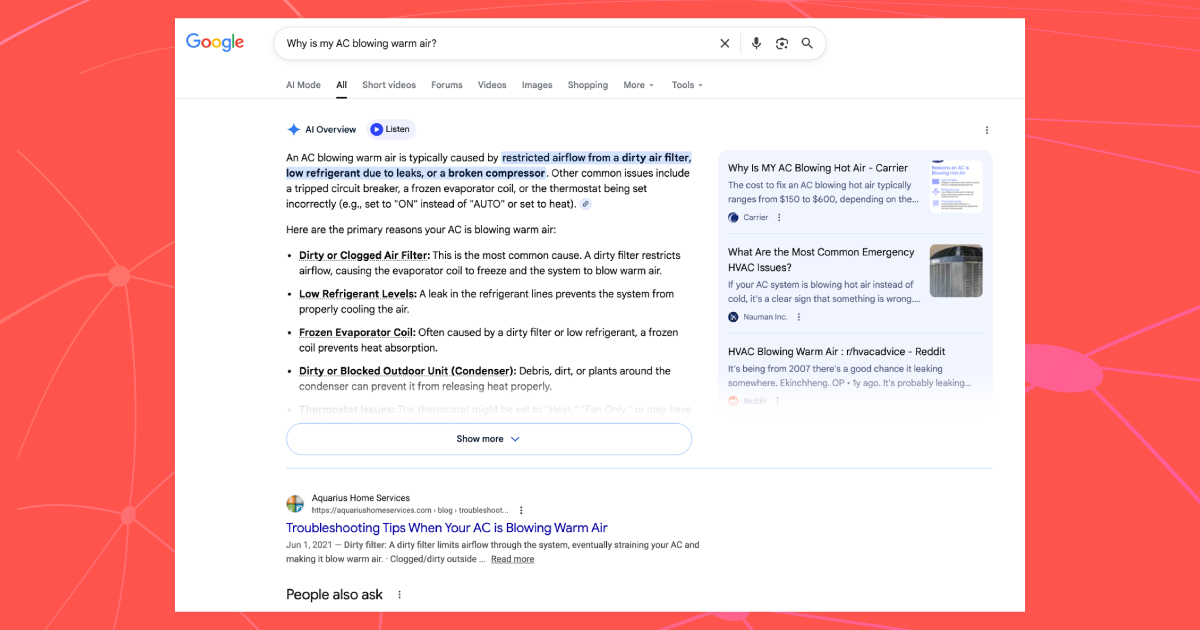
Instead of acting purely as directories, search engines are increasingly acting as interpreters. They summarize, compare, and synthesize data before users ever visit a site, displaying the necessary information right at the top of search engine results pages (SERPs). This has resulted in 60% of searches ending without a click. In many cases, users arrive later in their decision process, with more context and more specific expectations.
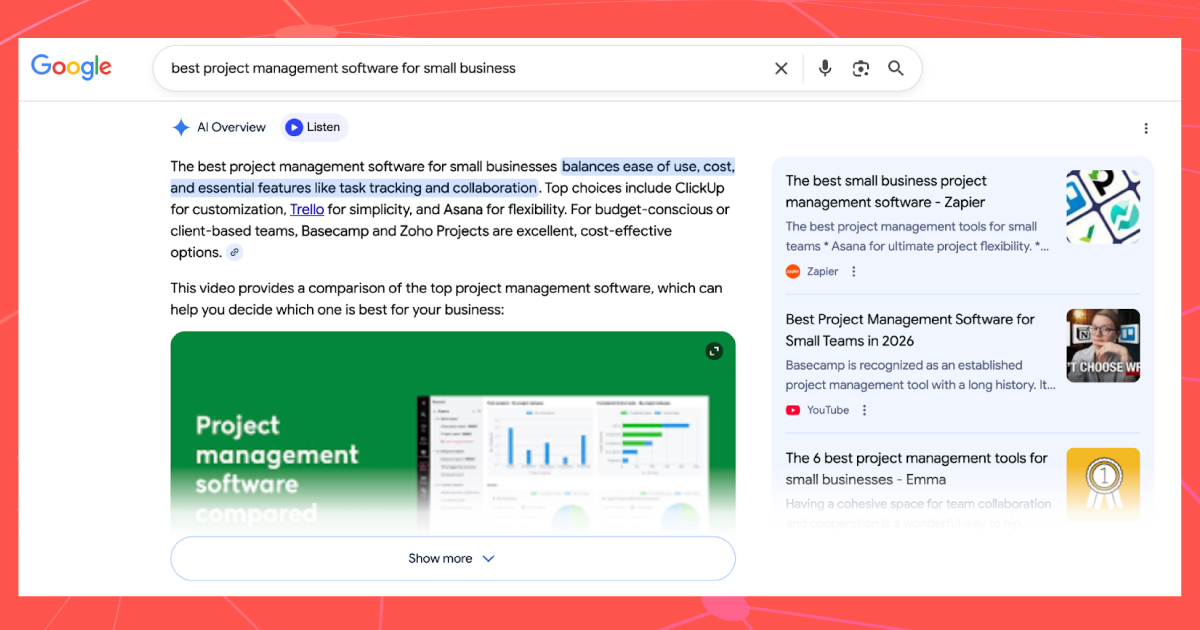
That shift affects how visibility is earned. Old-school SEO strategies aren’t enough anymore. Your content isn’t just competing with other websites; it’s going head-to-head with direct answers and AI-generated summaries.
Being present in search no longer means only ranking in a top position through keyword optimization and backlinks. It now requires being referenced, summarized, or implicitly trusted as a reliable source, even when a click doesn’t immediately follow.
This doesn’t eliminate the value of SEO. It simply changes how that value appears. Some searches now produce fewer clicks overall. Some content contributes to influence rather than direct sessions. And some organic impact happens upstream or across channels, rather than in a linear attribution line.
Gen AI has moved search closer to its original goal: delivering the most helpful, relevant information from people-first-minded brands.
Why This Shift Has Been Disruptive
AI alone shouldn’t be blamed for the shift. Rather, it stems from the gap between how SEO has traditionally been measured and how people search for information today.
Before the rise of the robots, many brands evaluated SEO through a narrow set of signals, including keyword rankings, organic traffic growth, and month-over-month changes. These metrics still matter, but they no longer tell the whole story.
This means that impressions may increase while clicks flatten. Organic sessions can dip slightly, but assisted conversions grow. Or a single high-ranking keyword becomes less meaningful than a broader footprint across related questions and themes.
Without the right context, those patterns can appear to indicate decline. In context, they often reflect a system that filters and qualifies users before they ever reach your website.
This is why so many businesses feel unsettled right now. The numbers don’t look wrong, but they don’t line up neatly with past expectations either.
What Strong SEO Guidance Looks Like Today
One of the biggest changes we’ve experienced at Square 205 isn’t in the work itself. It’s in how we talk about the work with clients.
Their questions have changed. Conversations that once focused on exact rankings now center on visibility, authority, and influence. Google’s new E-E-A-T guidelines, standing for Experience, Expertise, Authoritativeness, and Trustworthiness, now determine what content is most valuable to consumers, and our clients want to understand whether they’re being seen as a trusted, authoritative source, and whether they’re still playing a meaningful role in how customers make decisions.
That’s why when we explain AI-driven changes, we don’t start with updates or technical mechanics. We start with how people search today, what they see first, and how trust is established from the get-go. That framing immediately grounds the conversation in reality.
“One of the biggest mistakes we see right now is assuming all traffic is good traffic. With AI increasingly handling top-of-funnel education, we’ve stopped optimizing for volume and started optimizing for intent. Today, success in SEO looks less like more visits and more like attracting the people who actually need you and seeing that visibility turn into real revenue.”
~Joshua MacFall-Grace, Director of Growth
Across multiple engagements, a few consistent patterns have emerged. Because of E-E-A-T, brands with real-world expertise and original perspectives tend to maintain, or even boost, their organic presence, even when traffic behaves differently. Sites with strong structure, high-quality content, and credible authority signals are more likely to be surfaced or referenced by AI-powered experiences. And SEO performance is increasingly intertwined with UX, analytics interpretation, and brand clarity.
Internally, this has reshaped how we define success. Rankings and traffic are still important, but they’re no longer the top priority. Our SEO team focuses on topical authority, technical performance, and how organic search supports other channels over time. The goal now is to earn durable relevance.
Signs Your SEO Strategy Is in Good Hands
Thoughtful SEO partners focus first on understanding. They explain what matters now, why certain metrics may behave differently, and how short-term fluctuations connect to long-term health.
They also think in terms of horizons rather than months. Quick wins are valuable, but they’re evaluated alongside site quality, content depth, and authority, things that compound slowly but sustain performance. We’ve learned to de-emphasize metrics that once dominated conversations. Raw keyword counts and isolated traffic spikes rarely tell a meaningful story on their own.
Another important indicator is how naturally SEO connects to your long-term business outcomes. Strong strategies account for how organic visibility indirectly influences growth through early discovery, repeat visits, and cross-channel reinforcement. SEO must be discussed within a broader ecosystem rather than as a siloed channel.
Signs It May Be Time to Ask Hard Questions
Certain findings suggest a client’s SEO approach may no longer be effective.
We often encounter them during audits or when taking over inherited accounts. Keyword stuffing and low-quality backlinks can trigger algorithmic downgrades or even manual penalties. Other pitfalls include:
- Content plans driven by volume rather than usefulness or originality
- Little attention is paid to UX, trust signals, or overall site quality
- AI is framed either as a threat to fear or a trend to ignore
Rigidity is also a red flag. Search evolves more every day, and strong guidance reflects that reality. If recommendations sound overly confident, dismissive of recent changes, or rooted in how SEO worked five years ago, it may be time to ask tougher questions.
This isn’t about blame. It’s about alignment. The right partner should be comfortable acknowledging uncertainty, explaining tradeoffs, and embracing change.
How to Evaluate an Agency Without Becoming an Expert
You don’t have to be a digital marketing whiz-kid to gauge an agency’s SEO expertise. All you need is clarity.
Ask how an agency’s approach has changed in response to AI-driven search experiences. Question how they define success beyond rankings and traffic. Look at which signals they prioritize when assessing long-term organic health. And ask how SEO, content, UX, and analytics work together in practice. A stellar agency always takes a holistic approach.
Also, pay attention to how you feel after the conversation. Do you feel more informed? Or did the agency leave you with more questions than answers? Always trust your gut.
Clarity Boosts SEO Confidence
Generative AI hasn’t killed SEO. It has just accelerated the shift toward quality, authority, and usefulness, principles that were always meant to sit at the heart of search.
The real risk for brands isn’t AI itself. It’s working with partners who can’t clearly explain what’s changing, what isn’t, and how strategy should adapt.
SEO success today comes from working with teams who can translate complexity into clarity, adapt thoughtfully, and build durable digital value over time. When that happens, SEO becomes an asset, not a mystery.
Ready to gain more confidence? Square 205 is here to bring clarity to the SEO chaos. Reach out to us today.
